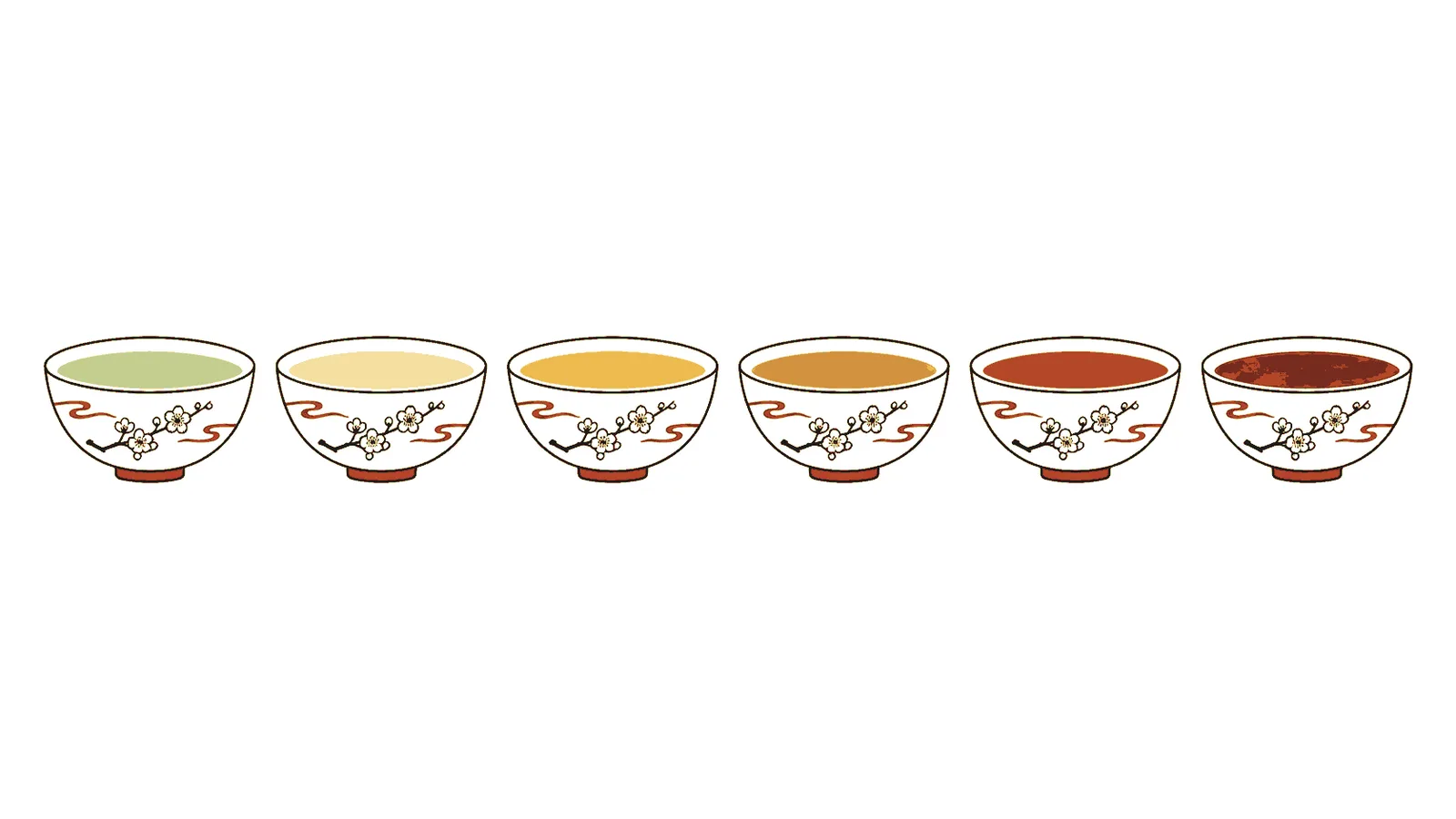
Chinese tea is sorted into six families — green, white, yellow, oolong (qīng, “blue-green”), black (hóng, “red” in Chinese) and dark — by how the freshly picked leaf is processed, not by region, price or aroma. Two different mechanisms divide them: how far the leaf’s own enzymes are allowed to oxidize before heat stops the reaction, and whether microbes ferment the leaf afterward, the step that turns dark tea dark. All six come from one species, Camellia sinensis.
The six families at a glance
| Family | Chinese | Defining step | Familiar examples |
|---|---|---|---|
| Green | 绿茶 lǜchā | Kill-green: heat stops oxidation early | Longjing, Biluochun |
| White | 白茶 báichá | Wither and dry; no kill-green, no rolling | Baihao Yinzhen, Bai Mudan |
| Yellow | 黄茶 huángchā | Men huang, a warm damp “sealing yellow” rest | Junshan Yinzhen, Mengding Huangya |
| Oolong | 青茶 qīngchā | Zuo qing: bruise, rest, repeat — then roast | Tieguanyin, Da Hong Pao |
| Black | 红茶 hóngchā | Full oxidation before drying | Zhengshan Xiaozhong, Keemun |
| Dark | 黑茶 hēichā | Wo dui wet-piling: microbial post-fermentation | Ripe pu’er, Liubao |
One plant, many techniques
A bush in Anxi and a bush in Fuding can be the same species. Cultivar, soil, altitude and picking season all shift the flavor, but processing decides which family lands in your cup. The six-family framework itself is modern; tea scholars usually credit it to Chen Chuan’s classification research in the late 1970s, drawing on earlier local practice. In 2022, “traditional tea processing techniques and their associated social practices in China” joined UNESCO’s intangible heritage list, covering green, oolong, dark and scented teas among more than 40 national heritage items.
Oxidation and post-fermentation are different axes
This is the part most tea charts get wrong. After picking, enzymes inside the leaf begin browning it when the cells are bruised or left alone. That browning is enzymatic oxidation, and every family stops or allows it at a different point.
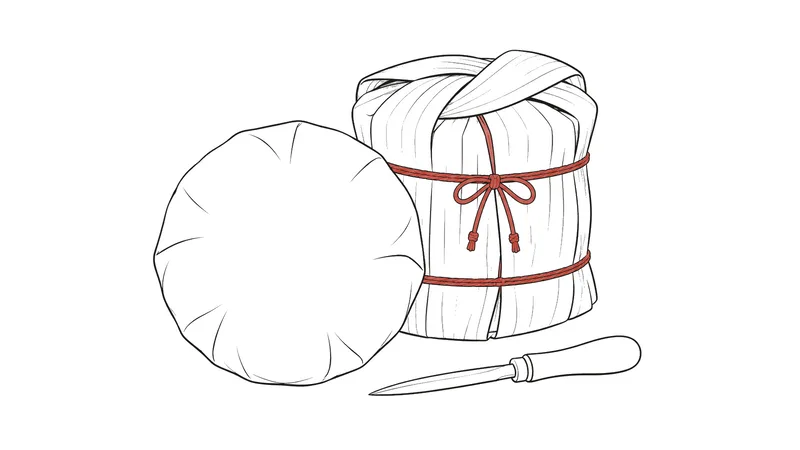
Green tea is heated first — in a wok, a drum, or with steam — in a step called kill-green (shā qīng). Heat deactivates the enzymes, so the leaf stays green and grassy. White tea takes the opposite route: no heat, no rolling, just a slow wither in air, so a little oxidation happens gently. Yellow tea gets its own move, men huang (“sealing yellow”), where still-warm leaf is wrapped or piled damp until it softens and loses its raw edge. Oolong does zuo qing: leaves are tossed in bamboo drums, rested, and tossed again, so the edges brown while the centers stay green — partial and deliberately uneven. Black tea is rolled to break cells and left to oxidize almost completely before drying.
Dark tea sits on a separate axis entirely. Ripe pu’er is the clearest example: after kill-green and rolling, the leaf is piled warm and damp so microbes go to work — wo dui, wet-piling. That is true fermentation, and it is why dark tea is not simply “very oxidized black tea.” Raw pu’er is a separate style and does not undergo wet-piling.
Green: the pan-fired family
Longjing (Dragon Well) from the hills west of Hangzhou is the reference point: flat, smooth leaves pressed in a hot wok, a smell often described as roasted soy bean or chestnut. The Qianlong emperor visited Longjing four times on his six tours south and wrote a set of poems known as the Longjing Eight Recitations, preserved in the Qing imperial poetry collection. The famous “eighteen imperial bushes” are tradition, not documented history. Biluochun, from Suzhou, curls into tiny snail shapes and smells of fresh fruit.
White: wither, then dry
White tea comes mainly from Fuding and Zhenghe in Fujian. The craft is almost nothing: wither the leaf, dry it. No kill-green, no rolling. Baihao Yinzhen (Silver Needle) is made from solitary downy buds; Bai Mudan (White Peony) uses a bud with a leaf or two. “Least processed” does not mean “unprocessed” — a good wither takes careful timing and airflow.
Yellow: the rarest shelf
Yellow tea is the smallest family and the one most travelers have never tasted. The men huang step gently transforms the leaf after kill-green, leaving a softer, sweeter cup than green tea. Junshan Yinzhen comes from an island in Dongting Lake in Hunan; Mengding Huangya comes from Mount Meng in Sichuan.
Oolong: bruise, rest, roast
Oolong is the tinkerer’s family. The repeated bruising of zuo qing creates the floral, fruity, sometimes creamy aromas, and a final roast sets the style. Tieguanyin from Anxi, Fujian, is prized for what drinkers call yinyun, a lingering “Guanyin rhyme.” Its origin stories — a tea farmer named Wei Yin dreaming of the Bodhisattva Guanyin, or a scholar named Wang Shirang finding the bush on a cliff — are legend, not history. Modern Tieguanyin is sold in light-aroma, strong-aroma and aged styles.
Da Hong Pao is Wuyi rock tea from northern Fujian, grown in mineral-rich valleys that give the sensory quality drinkers call yan yun, “rock rhyme” — a tasting word, not a lab measurement. Later sources say the mother trees on the Jiulongke cliff are protected from picking. Almost every Da Hong Pao sold today is a blend or a commercial name, not mother-tree leaf.
Black: one tea, two names
Chinese calls this family red tea, after the liquor; English calls it black, after the dry leaf. Both are correct. Zhengshan Xiaozhong from Tongmu Pass in the Wuyi mountains is widely considered the earliest black tea, and later sources describe it as an early export tea. Keemun from Anhui brings a cocoa-and-orchid profile that made it a favorite in the export trade.
Dark: time and microbes
Pu’er comes from Yunnan and takes its name from the Qing-era Pu’er prefecture, a collection and distribution center. The Tang-era text Manshu by Fan Chuo notes “tea grows in the mountains within the territory of Yinsheng,” one of the earliest written tea references for Yunnan. Pu’er exists in raw (sheng) and ripe (shou) styles. Ripe pu’er is the style transformed by the wo dui wet-piling method, which was developed in the 1970s, not in antiquity. Raw pu’er does not undergo wet-piling. Ripe pu’er belongs to the post-fermented dark tea family, as do Guangxi’s Liubao and Hunan’s fu brick.
Not tea, still on the table
Chrysanthemum, rose, goji and dried tangerine peel are not Camellia sinensis. In English, call them herbal infusions or tisanes; in Chinese, they often travel as dai cha yin, “tea substitutes,” a category with a long paper trail in food writings such as the Yuan dynasty Yinshan Zhengyao. None of this is a health story — it’s flavor, aroma and habit. If you are watching caffeine, note that any blend containing true tea leaves will carry it.
Where to start
Taste in pairs. Sip a green beside a white to feel what heat does and doesn’t do. Then try one floral oolong and one roasted oolong, same leaf, two treatments. Finish with a black and a dark tea, side by side, and the oxidation-versus-fermentation difference stops being abstract. Lu Yu, writing in the Classic of Tea around 780, ranked water itself: mountain spring first, river water second, well water last (Chajing, chapter five). Brew small, taste slowly, and keep notes — a tea table rewards curiosity more than equipment.
Questions, answered
What are the six types of Chinese tea?
Green, white, yellow, oolong (blue-green), black (called red tea in Chinese) and dark. They are sorted by processing, not by region or flavor. All six come from the same plant, Camellia sinensis, but each takes a different path after picking.
Is oolong a kind of black tea?
No. Oolong is partly oxidized: the leaf edges brown while the centers stay green, and the tea is often roasted afterward. Black tea is allowed to oxidize almost fully before drying, which darkens the whole leaf. Different steps, different families.
Why is black tea called red tea in Chinese?
Because the two languages look at different parts of the tea. Chinese names the family by the color of the brewed liquid (红, red). English names it by the color of the dried leaf (black). Same tea, two viewpoints.
Is pu'er a black tea?
In Chinese classification, no. Chinese “black tea” (红茶) is what English calls black tea, and it is fully oxidized. Pu'er belongs to dark tea (黑茶). Ripe pu'er is transformed by microbes during wet-piling; raw pu'er is a separate style that does not undergo that step. Black tea and dark tea sit on different axes of processing.
Does Chinese tea contain caffeine?
All true tea from Camellia sinensis contains caffeine naturally, including green, white and yellow tea. Herbal infusions vary by ingredient, and blends that include tea leaves or certain other plants may contain caffeine too, so check the ingredient list.