Chinese zodiac compatibility is a folk-culture system that groups the 12 animals into six harmony pairs, four three-harmony circles, and six clash pairs. It is not a scientific prediction or a verdict on relationships. Think of it as a traditional conversation starter: a way to compare signs, tell stories, and play a party game.
What the 12 Signs Are
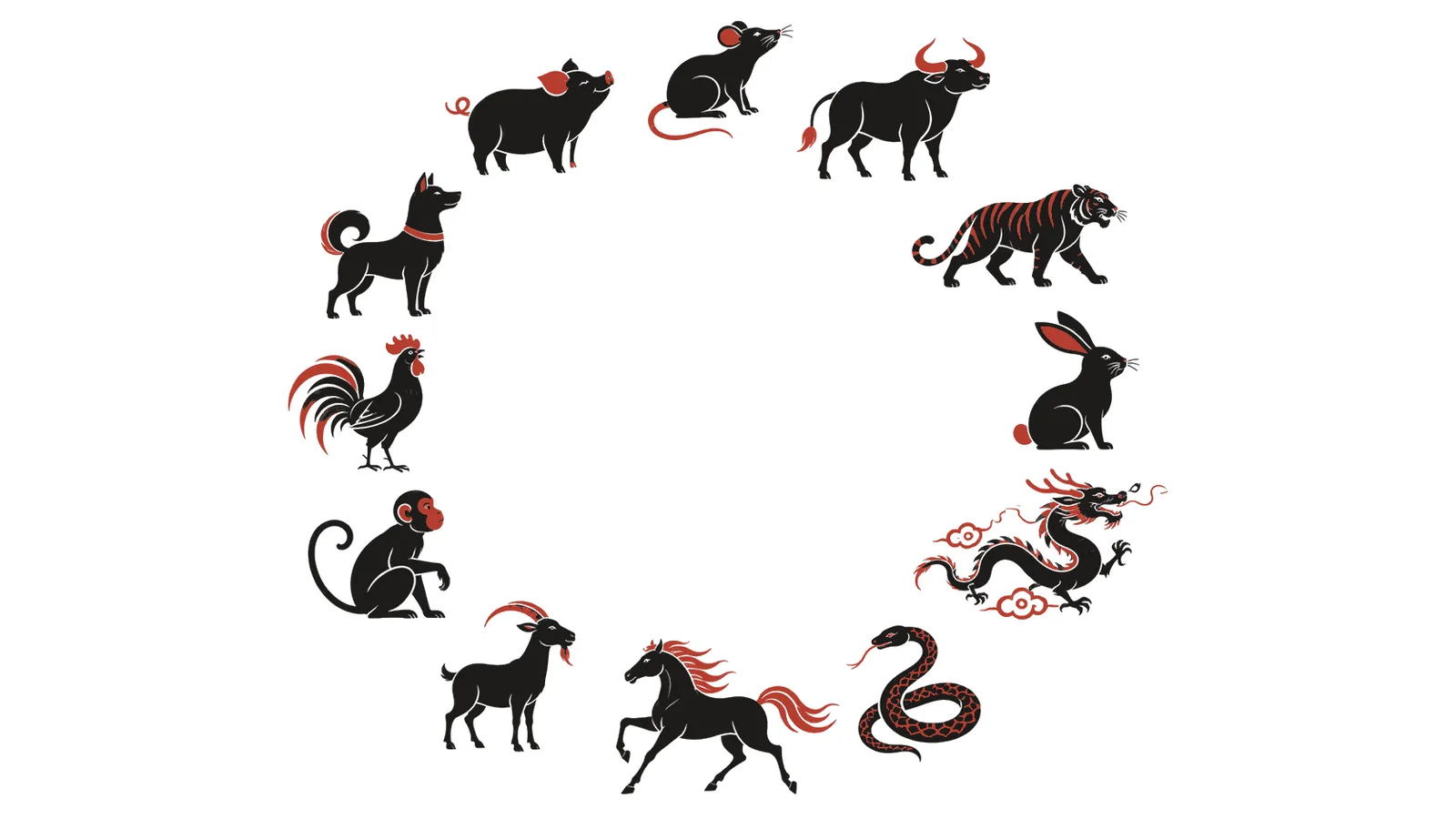
The 12 animals are paired with the 12 earthly branches. An early systematic pairing appears in Wang Chong’s Lunheng, “Wushi” chapter, though the wording differs from today’s common list (Lunheng, Wushi chapter). The famous “Great Zodiac Race” is a folktale with many versions, not a text from the Shan Hai Jing. According to legend, the animals raced across a river; in different tellings, the rat rides the ox, the cat misses out, and the order shifts. That is legend, not history. In daily folk use, the animals work as memory hooks: a year, a branch, an idiom, a story. A compatibility table is another hook—one that turns a list of animals into a social prompt.
Six Harmonies: The “Best” Folk Pair
Tradition holds that six animal pairs form the six harmonies, or liuhe. They are:
- Rat and Ox
- Tiger and Pig
- Rabbit and Dog
- Dragon and Rooster
- Snake and Monkey
- Horse and Goat
In the matrix below, these pairs are marked best. “Best” is a folk label. It means the two animals belong to a traditional harmony list. It does not mean two people are destined for anything, and it does not replace getting to know someone. You can remember the pairs as memory images—small and steady, bold and easygoing, gentle and loyal, loud and precise, quiet and clever, fast and calm—but those are mnemonic pictures, not personality tests.
Three Harmonies: Four Friendly Circles
Folk tables also group the animals into four three-harmony circles, or sanhe. Any two animals in the same circle are marked good:
- Rat, Dragon, Monkey
- Ox, Snake, Rooster
- Tiger, Horse, Dog
- Rabbit, Goat, Pig
These circles are often used in almanacs and calendar art as a kind of shorthand. For a party, they make easy teams: draw a circle, pick two signs, and ask what that animal trio would bring to a picnic. A three-harmony circle is not a team of three in real life. It is a shorthand from calendar tables. In a party deck, you can use each circle as a team color.
Six Clashes: The Folk “Clash” Label
The six clash pairs, or liuchong, are:
- Rat and Horse
- Ox and Goat
- Tiger and Monkey
- Rabbit and Rooster
- Dragon and Dog
- Snake and Pig
In the matrix, these are marked clash. In folk custom, a clash pair is often treated as opposite or argumentative. This page treats “clash” as a playful label, not a breakup forecast or a warning. A clash card is a prompt: “You two are the Rat and the Horse—how would you rewrite the zodiac race so both of you win?” In some almanacs, the clash is used for choosing dates or directions. This page does not use it that way. Here, the clash is a conversation starter, nothing more.
How to Read the 12×12 Matrix
The JSON block at the end of this page gives every pair. Find the first animal’s row and the second animal’s column. The labels work like this:
- Best = six harmony pair
- Good = three harmony circle
- Clash = six clash pair
- Neutral = no special folk pairing
The diagonal is neutral: a sign paired with itself is not a harmony or clash in these folk tables. The matrix is symmetric, so Rat–Ox and Ox–Rat get the same label. If you are building your own tool, keep the matrix symmetric and add a visible note that these are folk labels. The JSON below uses lowercase English animal names, so “goat” covers the Chinese 羊 that can also appear in English as sheep or ram.
A Party Game, Not a Prediction
Use the matrix as a social game. Pick two signs, read the folk label, then draw a conversation card. Some examples:
- “Design a tea table for these two animals.”
- “Which animal would host the best family dinner?”
- “If your signs clash, what is one thing you would change about the zodiac race?”
- “Make a two-animal team name for a paper boat race.”
- “Write a one-line story for this pair and vote on the funniest.”
Zodiac compatibility is folk culture and play. It is not a real prediction, and it should never be used to judge a partner, friend, coworker, or anyone’s future. Keep it warm, keep it silly, and keep the focus on stories, art, and conversation.
A Note on Sources and Boundaries
The early animal–branch pairing is often cited from Lunheng, “Wushi” chapter; the wording there is not identical to modern popular lists. The six harmonies, three harmonies, and six clashes are traditional almanac-style categories. Different regions and books may phrase them differently, so treat the labels as folk custom rather than a single fixed rule. The Great Zodiac Race belongs to oral storytelling, not to the Shan Hai Jing. No health, medical, or fortune-telling claims are made here.
Questions, answered
What is Chinese zodiac compatibility?
It is a folk-culture way of grouping the 12 zodiac animals by six harmony pairs, four three-harmony circles, and six clash pairs. This page uses it as a social game and cultural conversation starter, not as a prediction about real relationships.
Which zodiac signs are best matches?
In the folk tables used here, the six harmony pairs are Rat–Ox, Tiger–Pig, Rabbit–Dog, Dragon–Rooster, Snake–Monkey, and Horse–Goat. “Best” is just a label for that list, not a guarantee of compatibility.
What are the six clashes?
The six clash pairs are Rat–Horse, Ox–Goat, Tiger–Monkey, Rabbit–Rooster, Dragon–Dog, and Snake–Pig. In folk custom they are often treated as opposites, but this page treats “clash” as a playful label, not a forecast.
Is Chinese zodiac compatibility accurate?
No. It is traditional folk culture, not science. Use it for fun, storytelling, and party prompts. Do not use it to judge a partner, friend, coworker, or anyone’s future.
How do I use the 12x12 matrix?
Pick two animals and find the row and column. Best means six harmony, good means three harmony, clash means six clash, and neutral means no special folk pairing. The matrix is symmetric, and same-sign pairs are neutral.